
Artificial Intelligence and the New Investment Cycle
It is impossible to read the news today without encountering stories about the enormous sums being spent on the development of artificial intelligence (AI). Five of the largest U.S. technology companies (Amazon, Alphabet, Microsoft, Meta, and Oracle) alone are expected to spend approximately $800 billion in 2026 and exceed $1 trillion in 2027. To put these numbers into perspective, the Congressional Budget Office estimates that defense spending for the United States in fiscal year 2026 will total $918 billion. The rapid acceleration of spending on AI infrastructure over the last few years has also been staggering. Stated simply by the Wall Street Journal, “The AI Build-Out Is Becoming the Biggest Economic Bet in U.S. History”.
As a percentage of GDP, AI investment in the U.S. will likely grow larger than the railroad, electrification, highway, and telecommunications/fiber outlays over the last century. What began as a smaller amount of spending by extremely profitable mega-cap technology companies has now broadened into an investment cycle involving semiconductor manufacturers, utility companies, data center operations, construction companies, banks, private credit funds, and the public bond market. For all intents and purposes, what this means is that AI has become increasingly intertwined with the U.S. economy, and this interdependence should only continue to strengthen.
From a macroeconomic perspective, the nascent AI buildout has produced both benefits and tradeoffs. On the positive side, capital spending has provided a major boost to the U.S. economy. The Treasury Department estimates AI-driven investment accounted for nearly 30% of GDP growth in 2025 (with the trend continuing into 2026). AI has also provided a significant lift to U.S. equity markets and those of certain other countries around the globe. On the other hand, one clear negative implication has been rising interest rates. Faster growth and corporate AI expenditures increasingly financed by debt have contributed to upward pressure on bond yields. Coupled with persistent U.S. deficits and higher energy prices, we may continue to see further increases in both Treasury yields and corporate bond spreads. The era of rock-bottom interest rates that followed the Global Financial Crisis of 2008 is over.
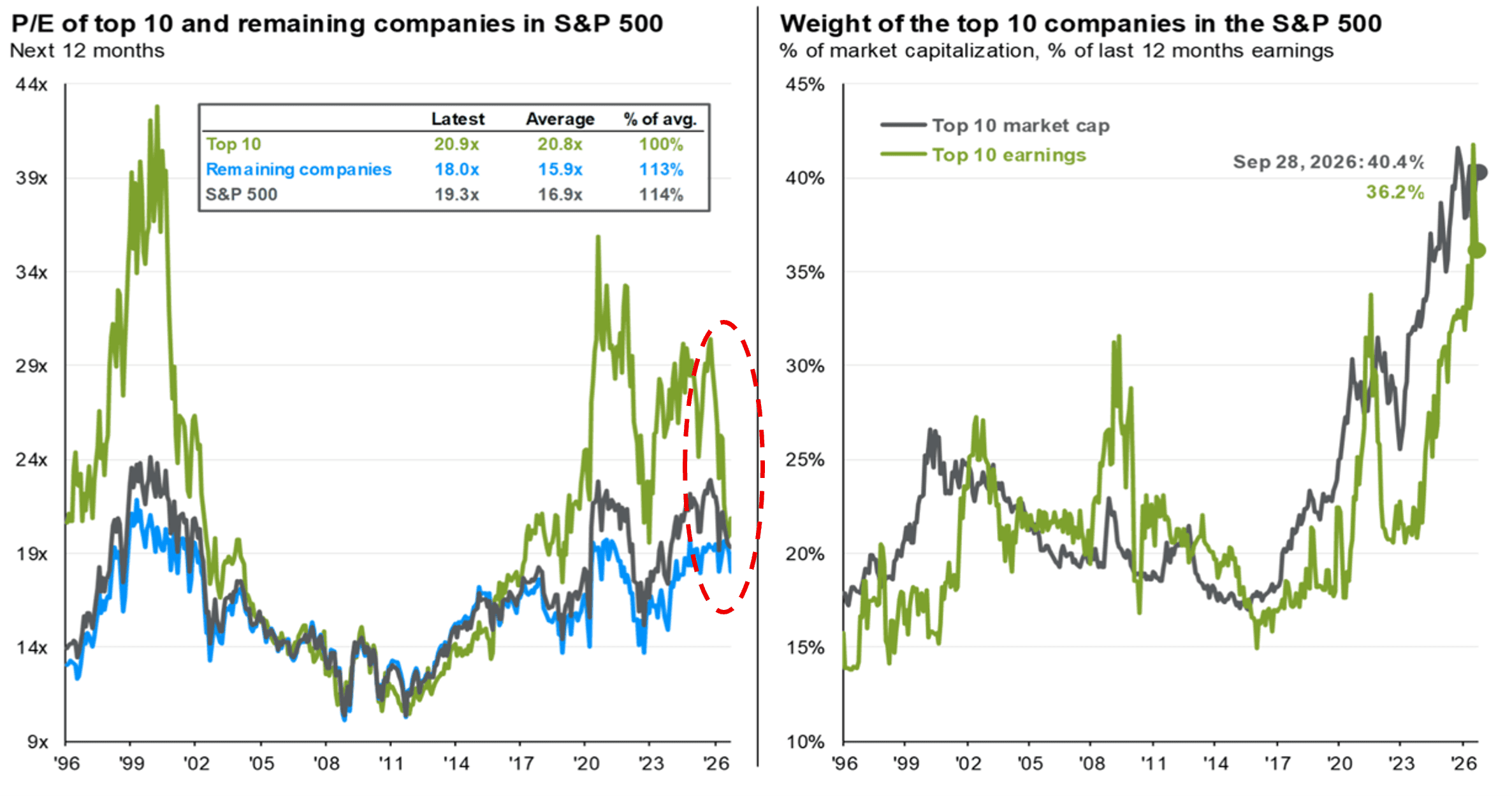
The sheer amount of spending has also led some investors to question whether parts of the AI complex are already in a bubble. The story is complex. The top 10 companies in the S&P 500 (most of which are significant participants in the AI ecosystem) make up 40% of the index’s total capitalization, a historically high degree of concentration. Valuations for certain AI-related stocks are rich, and some of them are trading with very high volatility. With that said, in my opinion, there is not a strong case for an “AI bubble” at present. While certain frontier AI labs like OpenAI are currently operating at a loss, the fundamental strength of the largest public market participants in the AI universe tells a different story. In fact, earnings from many mega-cap technology companies have been so strong of late that valuation metrics (for example, price-to-earnings ratios) have declined sharply from recent highs—refer to the green line in the left-hand figure below.1Source: J.P. Morgan Guide to the Markets®. FactSet, Standard & Poor’s, J.P. Morgan Asset Management. Forward P/E ratio is the most recent price divided by consensus estimates for earnings in the next 12 months, provided by IBES since January 1996 and FactSet since January 2022. The remaining stocks represent the rest of the 490 companies in the S&P 500, and their P/E ratio is calculated by backing out the nominal earnings and market cap of the top 10 from that of the S&P 500. Guide to the Markets – U.S. Data are as of September 28, 2026.
So where does that leave investors? Even if an investor wanted to avoid exposure to AI in his or her portfolio, this would be challenging to implement given its growing pervasiveness across the U.S. economy. Broad diversification is obviously the most impactful solution. Maintaining exposure to international regions around the globe can help reduce the risks associated with excessive concentration in a single country, sector, or industry. An investor could also modestly underweight the basket of mega-cap technology companies given their high degree of concentration in the U.S. market. Within a portfolio’s fixed income sleeve, keeping the maturity profile (interest rate sensitivity) skewed towards shorter-term bonds is another way to get exposure to attractive yields while also maintaining some downside protection from current interest rate and inflation volatility.
Ultimately, historical buildouts of new technologies (railroads, electrification, highway construction and, going back to the beginning of the country, canals) made sense and contributed to economic growth. Likewise, AI is simultaneously a source of economic growth today and a massive bet on economic growth tomorrow—eventually, this immense capital base will need to generate sufficient revenues to justify the investment. To the extent it does, the U.S. will likely experience a major pickup in GDP growth, deflationary effects from productivity enhancements, the birth of new industries, and a rising stock market (and vice versa on the downside). Given that a broad-based allocation to the U.S. equity markets will provide substantial exposure to AI moving forward, maintaining a properly diversified allocation will be of paramount importance—it will become the primary risk-control tool to ensure that a portfolio does not become overly dependent on a single outcome from this extraordinary investment cycle.